
One-minute read: Kibble can be convenient and nutritionally complete, but it is usually the driest, most processed, and easiest-to-overfeed way to feed a dog. Fresh or gently cooked food offers clear advantages in moisture and often performs better on digestibility, which is why it is worth seeing fresh food as the better direction — even if you start small.
For many dog owners, kibble feels like the obvious choice. It is convenient, easy to store, and widely seen as the “normal” way to feed a dog. And to be fair, a complete and balanced kibble from a reputable company can meet a dog’s basic nutrient requirements. But “meets requirements” is not the same as “best for long-term health.” That is the part many owners never really get told. The World Small Animal Veterinary Association (WSAVA) — a global veterinary association that publishes nutrition guidance for companion animals — makes that broader point clearly: the goal is an optimal, individually appropriate diet, not blind loyalty to one feeding method (WSAVA; WSAVA Global Nutrition Committee, 2018).
At MY DOG LAB, I do not believe in guilt-based feeding advice. This is not about telling people they are bad owners for feeding kibble. Most people feed kibble because it is practical, familiar, affordable, and heavily normalized. The better question is simply this:
if we can improve the bowl in a meaningful way, why would we not want to?
And when you look at the evidence honestly, fresh or gently cooked food often has advantages that kibble simply cannot fully match (WSAVA; WSAVA Global Nutrition Committee, 2018).
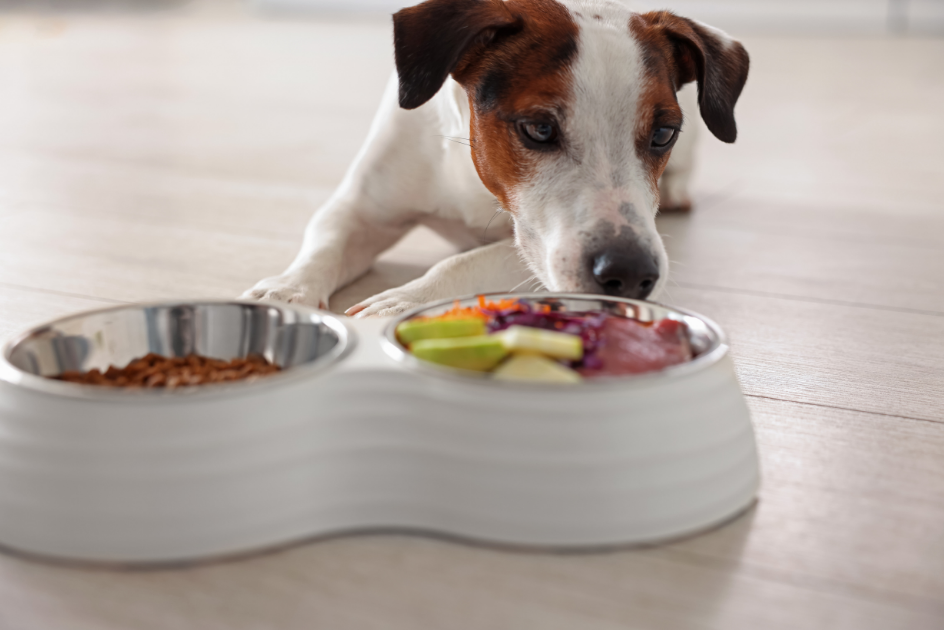
Fresh food brings back something kibble cannot: moisture
One of the clearest differences between kibble and fresh food is moisture. In a 2025 study, Sires and colleagues compared a fresh food with 71.1% moisture to dry kibble with 6.1% moisture. Dogs eating the fresh food had highertotal daily water intake and more comfortably exceeded their daily water requirement, even though kibble-fed dogs drank more from the bowl. The study also found differences in urine relative supersaturation, which matters for urinary health (Sires et al., 2025).
That matters because hydration supports far more than just thirst. It affects urinary health, digestion, stool quality, and overall physiological comfort. Fresh food naturally brings water into the bowl. Kibble does not. That does not mean every kibble-fed dog is dehydrated, but it does mean fresh food has a built-in advantage that dry food simply cannot match. If convenience were not driving the decision, this alone would make fresh food look much more attractive (Sires et al., 2025).
Fresh diets often make better use of the food
A second strong reason to lean toward fresh food is digestibility. In a 2021 study, Do and colleagues found that dogs fed human-grade foods had high digestibility, produced significantly less fecal output, and maintained normal serum chemistry and hematology. In practical terms, the dogs appeared to use more of the food and leave less behind (Do et al., 2021).
A 2022 study by Geary and colleagues found that a mildly cooked human-grade diet significantly altered the fecal microbiome of healthy adult dogs, again showing that food type is not nutritionally neutral. Fresh and gently cooked diets do not just look different from kibble — they behave differently in the body (Geary et al., 2022).
No single study proves that every fresh diet is superior to every kibble. Formulation still matters. But when research and lived experience point in the same direction — better moisture, strong digestibility, lower fecal output, and meaningful changes in the gut environment — that is not something I would brush off as marketing. It is a real reason to see fresh food as the better benchmark (Do et al., 2021; Geary et al., 2022).
Kibble is highly processed by design
Kibble is a manufactured product, usually made through extrusion. That process has obvious benefits: shelf life, convenience, consistency, and lower day-to-day effort for the owner. But it also means the final food is far removed from its original ingredients. Kayser and colleagues explain that carbohydrates play an important functional role in pet food manufacturing, especially in extruded diets. In other words, kibble does not just happen to contain starch; it relies on it as part of the processing system that makes kibble possible (Kayser et al., 2024).
Dogs can digest properly cooked starch, and I would not claim that “processed equals poison.” That would be sloppy. But I also do not think it makes sense to treat a dry, highly processed pellet as the gold standard simply because it is common. If we were designing a diet around the dog first, rather than around storage, manufacturing, and convenience, it is hard to believe we would naturally end up with kibble as the ideal. Fresh food is not interesting because it is trendy. It is interesting because it moves the bowl closer to moisture, less processing, and food that still looks and behaves more like food(Kayser et al., 2024; WSAVA Global Nutrition Committee, 2018).
The carbohydrate question matters — but it is not the main issue
Many kibble diets rely heavily on starch. Kayser and colleagues also note that dogs do not have a strict dietary requirement for carbohydrates, even though they can digest cooked starch well (Kayser et al., 2024). That does not mean carbohydrates are inherently bad. But it does mean they are often present in kibble because they are useful to the product itself, not because dogs biologically need a starch-heavy diet.
At the same time, I would avoid saying “kibble causes obesity because it is high in carbohydrates.” The dog-specific evidence is not that clean. The stronger drivers of weight gain are overall calorie excess, easy overfeeding, treats and extras, and poor portion accuracy. So the fairer message is this: kibble is often a dry, calorie-dense, starch-reliant format that can be easy to overfeed and not especially satiating for some dogs. That is a more useful and more defensible reason to question it (Murphy et al., 2021; Coe et al., 2019).
Kibble is very easy to overfeed
This is one of the most practical reasons kibble can become part of a health problem. In a 2019 study, Coe and colleagues asked dog owners to measure dry food using common tools. The errors ranged from -47.83% to +152.17% compared with the correct amount. That is not a small issue. Even well-meaning owners can overfeed by a lot without realizing it (Coe et al., 2019).
AAHA’s (the American Animal Hospital Association - a veterinary organization known for publishing evidence-based guidance and standards for companion animal care) nutrition and weight-management guidelines make the same broader point from a clinical perspective: all calories count, including snacks, table foods, and treats. WSAVA’s guidance also notes that treats should generally make up no more than about 10% of a dog’s daily calorie intake. So the problem is often not one scary ingredient on the label. It is the whole feeding pattern around the bowl: a dry, concentrated base diet, a scoop instead of a scale, and a few “little extras” that add up over time (Murphy et al., 2021; WSAVA Treats Guide).
There is also early long-term evidence pointing away from ultra-processed dry feeding
One reason I think fresh food deserves to be the direction owners lean toward is that the evidence is no longer limited to stool quality and digestibility. A 2023 Scientific Reports study by Vuori and colleagues found that feeding more non-processed meat-based foods during puppyhood and adolescence was associated with lower odds of developing chronic gut problems later in life, while higher feeding of ultra-processed carbohydrate-based dry food was associated with higher odds. This was an observational study, so it does not prove causation. But it is still an important signal, and it points in a direction worth taking seriously (Vuori et al., 2023).
More recent research suggests that kibble and less processed diets are not metabolically the same. In a 2025 study, dogs fed kibble ended the trial with higher levels of several blood fats than dogs fed a raw meat-based diet. In simple terms, that means the kibble-fed dogs showed a less favorable blood fat profile. This does not mean every marker is equally harmful, but it does suggest that food type can influence how a dog handles fats in the body (Holm et al., 2025).
Kibble is not a real dental strategy
A lot of owners have been told that kibble helps clean teeth. That claim has been overstated for years. WSAVA’s global dental guidelines state it very plainly: standard dry dog food is not beneficial for oral health. Ordinary kibble should not be treated like a toothbrush in pellet form. Proper dental care is its own topic (WSAVA Dental Guidelines).
Fresh is better if it is done properly
This is important. A fresh diet is not automatically better just because it looks more natural. It still needs to be balanced, appropriate for the dog, and formulated properly. WSAVA’s nutrition guidance is very clear on that point. The goal is not simply “anti-kibble.” The goal is better nutrition, done well (WSAVA; WSAVA Global Nutrition Committee, 2018).
That is why I usually recommend progress over perfection. If a full switch to a properly formulated fresh or gently cooked diet is realistic, that is often the strongest upgrade. If not, even adding some fresh, dog-safe foods to the bowl can be a meaningful step in the right direction. Fresh toppers are not the same as a full fresh diet, but they can still improve moisture, food quality, and owner awareness of what is actually going into the bowl. Keeping extras sensible helps preserve balance while still moving in a better direction (WSAVA Treats Guide).
A better bowl does not have to start with an extreme decision
This is where many owners need more reassurance and less pressure. You do not have to throw out the kibble overnight. You do not have to become perfect. And you definitely do not need to feel judged. What matters most is improving the bowl in a thoughtful, sustainable way. For some dogs, that means switching fully to a properly formulated fresh or gently cooked diet. For others, it means starting smaller: adding moisture, improving portions, upgrading ingredients, or using fresh toppers wisely. Small changes can still be meaningful when they are done consistently (WSAVA; WSAVA Treats Guide).
The bottom line
Kibble is not poison, and feeding kibble does not make someone a bad dog owner. But when we look at the evidence calmly, kibble is usually the driest, most processed, and often the easiest-to-overfeed feeding method. Fresh and gently cooked diets offer clear advantages in moisture and often perform well on digestibility, while also moving the bowl closer to a less processed, more food-like standard. That is why I think fresh food should be seen as the better direction — not the extreme option (Sires et al., 2025; Do et al., 2021).
Want to improve your dog’s bowl, but not sure where to start?
At MY DOG LAB, I help dog owners make smarter nutrition choices based on science, not trends or fear. Whether you want to switch from kibble to fresh food, improve your current feeding routine, or simply add the right fresh foods to the bowl, the goal is always the same: a healthier, more informed, and more realistic approach to feeding your dog.
References
WSAVA. Global Nutrition Guidelines.
https://wsava.org/global-guidelines/global-nutrition-guidelines/
WSAVA. About WSAVA.
https://wsava.org/about-us/
WSAVA Global Nutrition Committee. Frequently Asked Questions & Myths.
https://wsava.org/wp-content/uploads/2020/01/Frequently-Asked-Questions-and-Myths.pdf
Sires R, Yamka R, Wakshlag J. 2025. Feeding fresh food and providing water ad libitum is clinically proven to exceed calculated daily water requirements and impact urine relative supersaturation in dogs.
https://pubmed.ncbi.nlm.nih.gov/41280431/
Do S, Phungviwatnikul T, de Godoy MRC, Swanson KS. 2021. Nutrient digestibility and fecal characteristics, microbiota, and metabolites in dogs fed human-grade foods.
https://pubmed.ncbi.nlm.nih.gov/33511410/
Geary EL, Oba PM, Applegate CC, Clark LV, Fields CJ, Swanson KS. 2022. Effects of a mildly cooked human-grade dog diet on gene expression, skin and coat health measures, and fecal microbiota of healthy adult dogs.
https://pubmed.ncbi.nlm.nih.gov/35965387/
Kayser E, Finet SE, de Godoy MRC. 2024. The role of carbohydrates in canine and feline nutrition.
https://pubmed.ncbi.nlm.nih.gov/38910951/
Coe JB, Rankovic A, LaVallée R, et al. 2019. Dog owner’s accuracy measuring different volumes of dry dog food using three different measuring devices.
https://pubmed.ncbi.nlm.nih.gov/31409751/
Murphy M, et al. 2021 AAHA Nutrition and Weight Management Guidelines for Dogs and Cats.
https://www.aaha.org/wp-content/uploads/globalassets/02-guidelines/2021-nutrition-and-weight-management/resourcepdfs/new-2021-aaha-nutrition-and-weight-management-guidelines-with-ref.pdf
WSAVA. Feeding Treats to Your Dog.
https://wsava.org/wp-content/uploads/2025/11/WSAVA_GuidetoTreats_Dogs_251107.pdf
WSAVA. Global Dental Guidelines.
https://wsava.org/wp-content/uploads/2020/01/Dental-Guidleines-for-endorsement_0.pdf
Vuori KA, Hemida M, Moore R, et al. 2023. The effect of puppyhood and adolescent diet on the incidence of chronic enteropathy in dogs later in life. Scientific Reports.
https://www.nature.com/articles/s41598-023-27866-z
Holm S, Baarman E, Anturaniemi J, et al. 2025. The effect of a kibble diet versus a raw meat-based diet on intermediary metabolism in healthy adult dogs.
https://pubmed.ncbi.nlm.nih.gov/41046069/